Barton arms
No coat of arms is yet known for any Ivegill Bartons, but various Barton coats of arms scattered around the north of England seem to tie together.
At Ormside, Cumbria
The coat of arms of the Bartons of Ormside is described in *Nicolson et al 1777 p407:
"And there was a family of Bartons at Ormshead; whose arms were, Azure, a bend within 3 harts heads Or; which seems to argue that they sprung from Hartsop in this parish"
At Barton, Cumbria
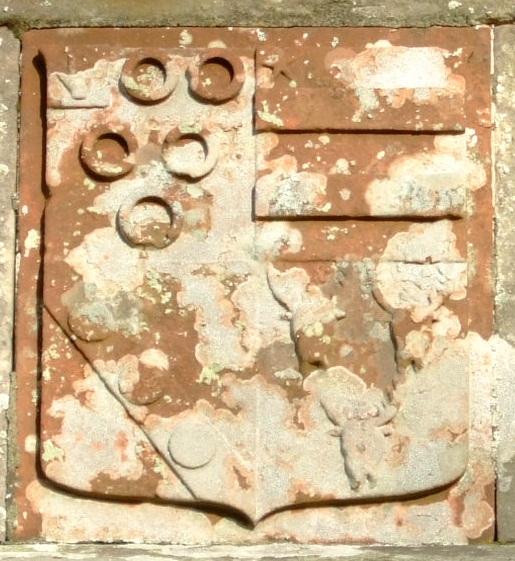
A similar coat of arms [above] on the parish church of Barton is discussed in *Transactions CWAAS v5 1905 p88:
"On the east side of the porch at Barton Church is an interesting shield of arms, concerning which some small error has arisen. It is supposed, and probably is, the armorial bearing of the family of Hartsop, of Hartsop in Patterdale. Nothing definite appears to be known about this family, and I have never come across the name except in Nicolson and Burn, who state that one of the Lancasters of Sockbridge, married an heiress of that family and quartered their arms. This is no doubt correct, in that the family of Lancaster did quarter these arms, but the name may not have been Hartsop. The small error I wish to correct is that the arms are incorrectly given in all the local books, and always without the tinctures. On carefully examining the shield, three cross crosslets are plainly visible between the tynes of the stag's horns, and in the visitation of Westmorland, 1615, the arms are given as arg. three stags' heads cabossed surmounted with cross crosslets fitchee gules."
At Whenby, Yorkshire
In 1528 Robert Barton of Ormside left land to "his cousin Henry Barton of Chempsforth in the county of Essex gentleman, remainder to Thomas Barton of Warcop, remainder to Andrew Barton of Smythylls in the county of Lancaster, remainder to John Barton of Whenby in the county of York in tail male, remainder to his own right heirs" *Nicolson et al 1777 pp515-517
A coat of arms of the Whenby Bartons is given in *Page 1923 pp211-214:

"Barton. Ermine a fesse gules with three rings or thereon."
According to John Lisle ([[http: httpwww.stedmanfamily.org|www.stedmanfamily.org]]), who cites the "Roll of Arms, Temp., Henry III (1216-1272)", this same coat of arms ("port d'ermiine, sur les fes gules, trois annulets d'or") earlier belonged to Sir John Barton, of Fryton and Steresby, Knight, thought to be the father of Robert de Barton, King's clerk in Carlisle (13th-14thC). N.B. Stearsby is only a stone's throw from Whenby, while Fryton is very close to Barton-le-Street (see map here).
At Burneside Hall, Lancashire
A Thomas Barton of Whenby married Alice Brathwaite of Burneside Hall near Kendal (*Transactions CWAAS v4 1904 pp316-317) wherein a Barton coat of arms is described in *Transactions CWAAS v6 1882 p105:
"The 11 Barton bears (if this be right) Quarterly 1 Ermine on a fess gules 3 annulets Or [matching the Whenby arms above]—the 2nd Paly of six Arg and vert, the 3 gules between 2 Bends or & ar 3 Lioncels pt arg the 4 gules a chevron Art charged with 3 hurts inter 3 fleur-de-lis Or. [similar to the Ormside and Barton arms?]"
Other arms
Elliott-Boileau arms
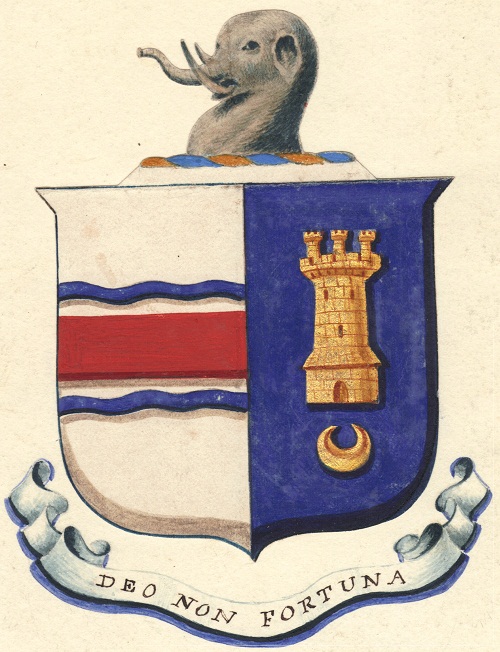
These arms (from the *NJB family archive) represent the 1802 marriage of Charles Elliott (1776-1856) to Alicia Boileau (1779-1851). They appear on a monument to them in St. Mary's Church, Tattingstone. The left half (the 'male position') is the Elliott arms while the right half (the 'female position') is the Boileau arms. The elephant is very likely a reference to India where the pair lived for many years. 'Deo non fortuna' means 'from God, not by chance'.
In the Boileau arms, the castle may represent Regnaud Boileau (d.1400) who was supposedly commissioned to build the castles of Nimes by King Charles VI of France in 1391. The crescent supposedly commemorates the death of Jean Boileau (d.1396) at the hands of the Turks whilst on crusade (presumably in the battle of Nicopolis).